Interior Design Cost in Kenya: Prices, Fees and Budget Guide
Planning to hire an interior designer in Kenya? Whether you want to transform a single room, furnish a new apartment or redesign an entire home, understanding interior design costs can help you plan your budget and avoid unexpected expenses.
The cost of interior design in Kenya depends on the size of the property, design requirements, materials, furniture, finishes and level of professional involvement. Some designers charge per square metre, while others use fixed project fees, hourly consultation rates or a percentage of the total project budget.
It is also important to distinguish between interior design fees and the cost of implementing the design. A designer’s professional fee may cover space planning, drawings, material selection and design supervision, while furniture, fittings, labour and installation may be charged separately.
This guide explains the estimated interior design prices in Kenya, what different services include, how to budget for individual rooms and how to choose an interior designer who offers value for money.

Quick Guide: How Much Does Interior Design Cost in Kenya?
Interior design costs vary considerably depending on the scope of work. Published Kenyan price guides provide the following indicative figures for planning purposes:
| Interior design service | Indicative price range |
|---|---|
| Design-only services per square metre | KES 1,500–10,000+ |
| Interior design per room | KES 25,000–150,000 |
| Hourly design consultation | KES 5,000–45,000 |
| Designer’s percentage-based fee | 10%–20% of project value |
| Living room furnishing and styling | KES 150,000–600,000 |
| Master bedroom furnishing | KES 100,000–450,000 |
| Kitchen design and cabinetry | KES 150,000–1,200,000 |
| Home office furnishing | KES 50,000–300,000 |
These are broad market examples drawn from published Kenyan interior design price guides, not fixed industry rates or SUIMAS quotations. Actual prices depend on the designer, project location, specifications and services included.
The most important step is to establish whether a quotation covers design only, furnishing, implementation or a complete interior design package.
1. How Do Interior Designers Charge in Kenya?
Interior designers use different pricing methods depending on the type and size of a project. Understanding these methods makes it easier to compare quotations.
A. Interior Design Cost Per Square Metre
Some designers calculate their fees according to the floor area being designed.
Indicative published design-only rates include:
| Design level | Approximate cost per m² |
|---|---|
| Basic or concept design | KES 1,500–4,000 |
| Detailed or mid-range design | KES 4,000–5,000 |
| Premium design and documentation | KES 5,000–10,000+ |
For example, if a designer charges KES 2,500 per m² for a 100 m² apartment, the estimated design fee would be KES 250,000.
However, confirm what the rate includes. A concept design may not include detailed construction drawings, electrical layouts, material schedules, procurement or site supervision.
B. Interior Design Cost Per Room
A designer may charge a fixed amount for each room. This is suitable for homeowners who want to upgrade selected spaces without redesigning the entire property.
Indicative published examples range from approximately KES 25,000 to KES 150,000 per room, depending on complexity and deliverables.
A simple bedroom consultation will usually require less work than a complete living room redesign involving custom furniture, lighting, window treatments and detailed drawings.
C. Fixed Project Fee
A fixed fee is agreed upon before work begins. It is useful when the scope of work is clearly defined.
For example, a homeowner may request a complete design proposal for a two-bedroom apartment. The designer assesses the property, agrees on the deliverables and provides one professional fee for the agreed work.
The contract should explain:
- Which rooms are included.
- Whether site measurements are included.
- Whether 2D layouts and 3D visualisations are provided.
- How many design revisions are allowed.
- Whether material and furniture selection is included.
- Whether site visits and implementation supervision are included.
D. Percentage-Based Interior Design Fees
Some designers charge a percentage of the overall project budget. Published Kenyan examples commonly show percentage-based fees around 10%–20%, although the actual agreement varies.
For example, if the agreed project implementation budget is KES 1,000,000 and the design fee is 10%, the professional fee would be KES 100,000.
Before agreeing to this arrangement, clarify how the project value is calculated and whether the percentage covers procurement, supervision or other services.
E. Hourly Consultation Fees
Hourly consultations are useful when you need professional advice but do not require a complete design package.
A consultation can help with:
- Choosing suitable colours and finishes.
- Improving furniture arrangement.
- Selecting flooring and wall finishes.
- Planning lighting.
- Reviewing an existing design.
- Establishing a realistic renovation budget.
Published Kenyan examples range from approximately KES 5,000 to KES 45,000 per hour, depending on the professional and consultation requirements.
2. Interior Design Cost Per Room in Kenya
The cost of designing and furnishing a room depends on its size, intended use, furniture requirements and finish quality.
The following estimates are useful for preliminary budgeting. They are not guaranteed quotations and may include different combinations of design, furniture and installation.
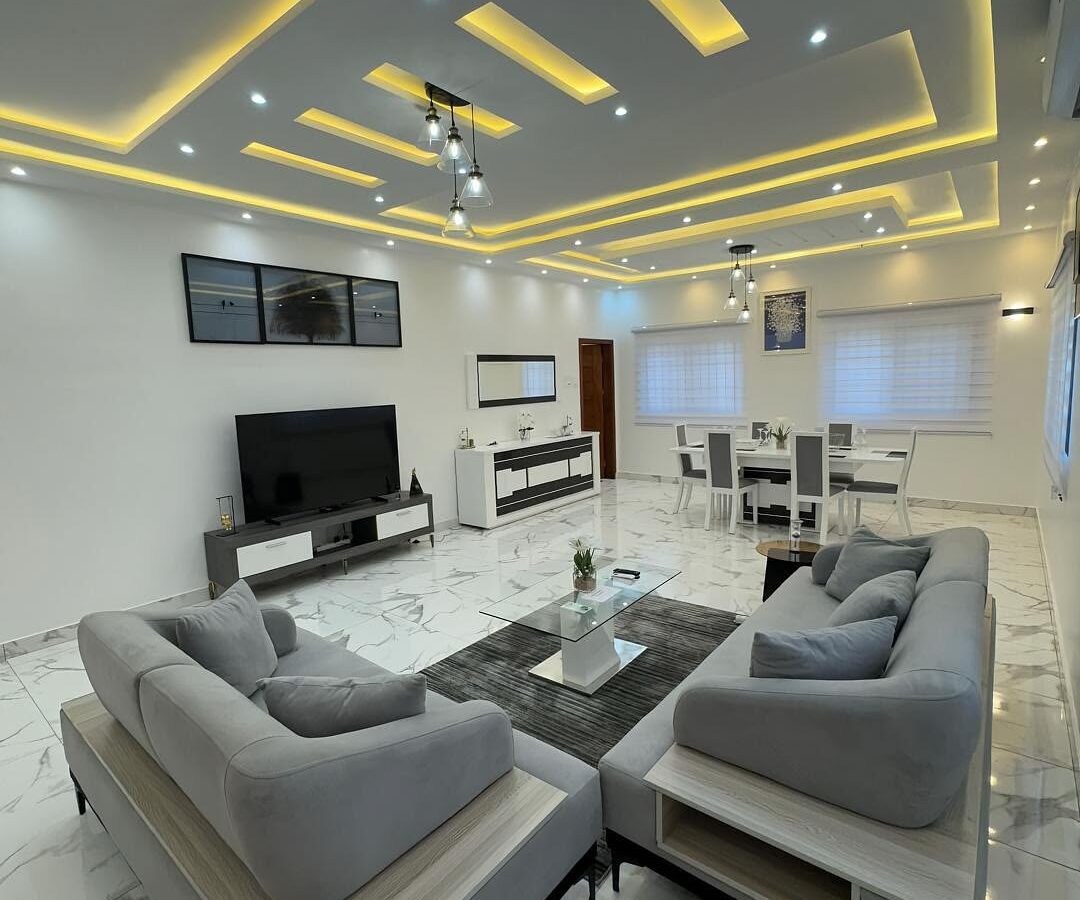
Living Room Interior Design Cost
Indicative furnishing and fit-out budget: KES 150,000–600,000.
The living room is often the main social space in a home. Its design should balance comfort, appearance and functionality.
Typical items include:
- Sofas and occasional chairs.
- Coffee tables and side tables.
- TV units and entertainment storage.
- Curtains and window treatments.
- Rugs and decorative accessories.
- Lighting fixtures.
- Wall finishes and feature walls.
- Artwork and decorative pieces.
A smaller living room with standard furniture may require a modest budget. A spacious living room with custom furniture, premium fabrics, feature lighting and bespoke finishes will cost more.
Master Bedroom Interior Design Cost
Indicative furnishing budget: KES 100,000–450,000.
A master bedroom should provide comfort, privacy and practical storage.
Common design requirements include:
- Bed and headboard.
- Bedside tables.
- Wardrobes and built-in storage.
- Dressing table or vanity.
- Curtains and blinds.
- Bedroom lighting.
- Rugs and decorative accessories.
- Wall finishes and feature panels.
Custom wardrobes, upholstered headboards and premium finishes can increase the total cost.
Standard Bedroom Interior Design Cost
Indicative furnishing budget: KES 60,000–200,000.
A standard bedroom may need a bed, wardrobe, bedside tables, curtains, lighting and simple décor.
For children’s bedrooms, the design may also include study desks, shelves, practical storage and durable finishes.
Kitchen Interior Design Cost
Indicative design and furnishing budget: KES 150,000–1,200,000.
Kitchen costs vary significantly because cabinetry, countertops, appliances and plumbing requirements can represent a substantial part of the budget.
Typical items include:
- Kitchen layout and space planning.
- Custom cabinets and drawers.
- Countertops.
- Backsplash tiles.
- Kitchen islands and breakfast counters.
- Sinks and taps.
- Lighting and electrical fittings.
- Appliance selection and integration.
- Storage solutions.
A kitchen requiring new cabinetry, premium countertops and extensive alterations will cost more than a kitchen receiving cosmetic improvements.
Explore SUIMAS kitchen and renovation services if you are planning a kitchen upgrade alongside your interior design project.
Bathroom Interior Design Cost
Indicative furnishing and renovation budget: KES 50,000–400,000.
Bathroom design may involve selecting tiles, sanitaryware, fittings, storage, lighting and shower enclosures.
A simple refresh may only require new accessories, mirrors and finishes. A complete bathroom transformation may involve plumbing alterations, waterproofing, tiling, a new vanity, shower installation and other construction work.
For a more detailed breakdown, see our guide to bathroom renovation costs in Kenya.
Dining Room Interior Design Cost
Indicative furnishing budget: KES 70,000–250,000.
A dining room budget may cover:
- Dining table and chairs.
- Pendant or feature lighting.
- Sideboards and storage.
- Wall décor and artwork.
- Rugs and accessories.
- Curtains and other window treatments.
The size of the dining area and the materials selected influence the final cost.
Home Office Interior Design Cost
Indicative furnishing budget: KES 50,000–300,000.
A home office should support productivity while remaining comfortable and visually consistent with the rest of the home.
Common requirements include an ergonomic desk and chair, storage cabinets, shelves, task lighting, electrical points and suitable wall finishes.
3. Cost of Furnishing a House in Kenya
If you are moving into a new property or furnishing an empty house, it is useful to estimate the budget according to the number of rooms.
The following are indicative furnishing budgets from published Kenyan guides:
| Property type | Approximate furnishing budget |
|---|---|
| Bedsitter | KES 100,000–250,000 |
| One-bedroom apartment | KES 200,000–500,000 |
| Two-bedroom apartment | KES 350,000–900,000 |
| Three-bedroom house | KES 500,000–1,500,000 |
| Four-bedroom house | KES 800,000–2,500,000+ |
These figures are broad furnishing examples. They should not be interpreted as complete construction or renovation costs.
A two-bedroom apartment, for instance, may require a different budget depending on whether it already has kitchen cabinets, wardrobes, lighting, curtains and bathroom fittings.
A fully furnished apartment with custom cabinetry and premium furniture will cost considerably more than one furnished with standard, ready-made items.
4. Interior Design Budget Categories: Basic, Mid-Range and Luxury
Your preferred design style and finish quality have a major influence on the total budget.
Basic or Budget Interior Design
A basic interior design project focuses on improving the appearance and functionality of a space without expensive custom features.
It may include:
- Standard furniture.
- Simple colour schemes.
- Affordable curtains and blinds.
- Basic lighting fixtures.
- Ready-made storage solutions.
- Practical flooring and wall finishes.
- Limited decorative accessories.
This approach is suitable for rental apartments, first-time homeowners and people working with a limited budget.
Mid-Range Interior Design
A mid-range project combines quality materials, improved functionality and coordinated design.
It may include:
- Better-quality furniture.
- Customised storage in selected areas.
- Decorative wall finishes.
- Modern lighting.
- Quality flooring.
- Improved kitchen and bedroom cabinetry.
- Coordinated curtains, rugs and accessories.
- Professional space planning and visualisation.
This category is appropriate for homeowners who want a polished interior without committing to the highest-end materials and furniture.
Luxury Interior Design
Luxury interior design focuses on bespoke solutions, premium finishes and detailed execution.
Common features include:
- Custom-designed furniture.
- Premium natural stone or high-quality surfaces.
- Bespoke cabinetry and joinery.
- Statement lighting.
- Designer fabrics and finishes.
- Advanced lighting controls.
- Detailed wall panelling and feature installations.
- Integrated storage and specialist fittings.
- High-quality accessories and artwork.
Luxury projects require careful coordination because custom furniture, specialist materials and more detailed installation work can increase costs.
5. Factors That Affect Interior Design Costs in Kenya
Two homes with the same number of bedrooms can have very different interior design budgets. The following factors explain why.
1. Size of the Property
Larger properties usually require more furniture, materials, design documentation and installation work.
However, cost does not always increase in direct proportion to floor area. A small apartment with extensive custom cabinetry may cost more per square metre than a larger home with a simple design.
2. Design Complexity
Simple layouts and standard finishes generally require less work than complex designs involving custom features, specialist lighting, detailed joinery and structural changes.
3. Quality of Materials
Material selection affects both the initial cost and long-term maintenance requirements.
Examples include:
- Natural stone compared with standard countertops.
- Solid timber compared with engineered boards.
- Premium upholstery compared with standard fabrics.
- Imported tiles compared with locally available alternatives.
- Custom lighting compared with standard fittings.
Choose materials according to your budget, intended use and maintenance expectations.
4. Furniture Selection
Ready-made furniture may be more affordable and easier to source. Custom furniture offers more control over dimensions, storage and appearance but may require additional design, manufacturing and installation costs.
5. Property Location
Transport, delivery, site access and the availability of skilled tradespeople can influence the project budget.
Projects outside major supply and service centres may require additional logistics allowances.
6. Existing Condition of the Property
An existing property may need repairs before the interior design can be implemented.
Examples include:
- Wall repairs and repainting.
- Plumbing adjustments.
- Electrical upgrades.
- Floor levelling.
- Ceiling repairs.
- Waterproofing.
- Replacement of damaged fittings.
These works should be identified before the final implementation budget is approved.
7. Professional Services and Project Management
Some clients need design advice only, while others require a team to coordinate purchasing, installation, contractors and final handover.
The more responsibility the designer takes on, the more important it becomes to define the professional fee and deliverables clearly.
6. Hidden Costs to Consider When Planning Interior Design
A common budgeting mistake is to account for furniture and finishes but overlook the additional expenses involved in completing a project.
Remember to consider:
| Potential additional cost | Why it matters |
|---|---|
| Transport and delivery | Furniture and materials must reach the property |
| Installation labour | Some items require professional fitting |
| Electrical work | New lighting or power points may require wiring changes |
| Plumbing work | Kitchen and bathroom changes may require adjustments |
| Painting and repairs | Existing surfaces may need preparation |
| Customisation | Special sizes or finishes can increase manufacturing costs |
| Waste removal | Renovation work may generate debris |
| Taxes and applicable charges | Confirm whether quoted prices include them |
| Project supervision | Site coordination may be charged separately |
It is also sensible to set aside a contingency allowance of approximately 10%–15% of the planned implementation budget for unforeseen work. The appropriate allowance depends on the condition of the property and the amount of renovation involved.
7. Is Hiring an Interior Designer in Kenya Worth the Cost?
Hiring an interior designer can be worthwhile when a project involves multiple rooms, significant furniture purchases, custom finishes or complex renovation work.
A professional designer can help you:
Make better space-planning decisions: Good layouts improve movement, storage and the practical use of available space.
Coordinate colours and materials: A consistent design helps prevent finishes, furniture and fittings from looking disconnected.
Plan purchases: A clear specification makes it easier to select furniture, lighting and materials that work together.
Avoid expensive mistakes: Measuring, planning and confirming specifications before purchasing can reduce the risk of unsuitable furniture and unnecessary alterations.
Coordinate the project: Where included in the agreement, professional oversight can help align contractors, suppliers and installation work.
However, hiring a designer does not automatically make every project cheaper. The value comes from better planning, suitable specifications and clear coordination.
8. How to Budget for an Interior Design Project
Before hiring an interior designer, take time to establish what you want to achieve and how much you can spend.
Step 1: Define Your Project Scope
Decide whether you want to design one room, furnish an entire house or renovate several spaces.
Write down the rooms involved and the main improvements required.
Step 2: Set a Realistic Budget
Determine the maximum amount you can comfortably spend.
Separate your budget into:
- Professional design fees.
- Furniture and accessories.
- Materials and finishes.
- Labour and installation.
- Transport and delivery.
- Repairs and other additional work.
- Contingency allowance.
Step 3: Prioritise Essential Improvements
If your budget is limited, focus on items that have the greatest impact on comfort and functionality.
For example, you may prioritise kitchen storage, bedroom wardrobes, living room furniture and suitable lighting before purchasing decorative accessories.
Step 4: Request a Detailed Quotation
Ask the designer to provide an itemised quotation that explains the services, materials, quantities and estimated costs.
Avoid comparing two quotations based only on their final totals. One may include design drawings, furniture sourcing and supervision, while another may cover design consultation only.
Step 5: Confirm the Payment Schedule
Agree on payment milestones before the project starts.
The agreement should explain when payments are due, what work each payment covers and how additional costs will be approved.
Step 6: Review the Design Before Implementation
Where possible, review the proposed layout, material selections, furniture dimensions and visualisations before approving purchases or construction.
This reduces the likelihood of costly changes during installation.
9. What Should Be Included in an Interior Design Quotation?
A professional quotation should make it clear what you are paying for.
Depending on the agreed service, it may include:
- Initial consultation and site assessment.
- Site measurements.
- Space planning and furniture layouts.
- Concept development and mood boards.
- 2D drawings and 3D visualisations.
- Colour and material specifications.
- Furniture and lighting selection.
- Custom cabinetry and joinery details.
- Procurement and supplier coordination.
- Installation and site supervision.
- Final inspection and handover.
Not every package includes all these services. Ask the designer to list exclusions as well as inclusions.
You should also clarify the number of revisions, project duration, purchasing arrangements and how variations will be handled.
10. Why Choose SUIMAS Interiors for Interior Design in Kenya?
At SUIMAS Interiors, we understand that every property has different requirements. A practical interior design project should reflect the client’s lifestyle, preferred style, available space and budget.
Our approach combines design planning with renovation and implementation services, helping clients coordinate different elements of their projects.
Our interior design services can include:
Space planning and layout design: We help organise rooms to improve movement, functionality and use of available space.
3D visualisation: Design concepts and visual presentations help clients understand the proposed direction before implementation.
Furniture selection and procurement: We assist with choosing furniture and coordinating suitable options for the intended space.
Lighting design: We help plan lighting solutions that support the function and appearance of each room.
Custom interior finishes: We coordinate selected finishes, storage solutions and decorative features to suit the design.
Project coordination and installation: Where included in the agreed scope, we coordinate implementation and finishing work.
You can explore our interior design services and complete renovation services to learn more about the solutions available.
For examples of our work, visit the SUIMAS project portfolio.
11. Request an Interior Design Quotation from SUIMAS Interiors
Are you planning to redesign your living room, furnish a new apartment, upgrade your kitchen or transform your entire home?
SUIMAS Interiors can help you assess your space, discuss your requirements and plan an interior design solution suited to your property.
To help us understand your project, share:
- Your property location.
- The type of property and approximate size.
- The rooms you want designed.
- Your preferred style or inspiration images.
- Your estimated budget.
- Whether you need design only or design and implementation.
Contact our team:
- Phone: 0717 044 443 / 0739 255 050 / 0725 021 709
- Email: info@suimas.co.ke / info@interiordesigners.co.ke
- Address: Solar House, Fourth Floor, Nairobi, Kenya
- Website: Renovation.co.ke
- Contact page: Request an interior design consultation
We can discuss your requirements and advise on the next steps towards a clear, itemised project quotation.
12. Frequently Asked Questions About Interior Design Costs in Kenya
How much does an interior designer charge in Kenya?
Interior designers use different fee structures, including per-square-metre rates, fixed project fees, hourly consultations and percentage-based fees. Published Kenyan examples include design-only rates of approximately KES 1,500–10,000+ per m², but the actual fee depends on the project and deliverables.
How much does interior design cost per square metre in Kenya?
Published examples range from approximately KES 1,500 to KES 10,000 or more per m² for design services. Confirm whether the rate includes concept development, drawings, 3D visualisation, material specifications and supervision.
How much does it cost to furnish a two-bedroom house in Kenya?
Published furnishing estimates for a two-bedroom apartment range from approximately KES 350,000 to KES 900,000. The final amount depends on the number of furniture items, quality of materials, appliances, curtains, lighting and custom storage.
Does an interior design fee include furniture?
Not necessarily. A design-only fee generally covers professional planning and design deliverables. Furniture, appliances, materials, delivery and installation may be charged separately. Always request a written breakdown.
Is it cheaper to hire an interior designer or buy furniture yourself?
Buying furniture independently may reduce professional design costs, but it does not necessarily guarantee a lower overall project cost. A designer can help with measurements, suitable selections, coordination and avoiding unsuitable purchases. The right option depends on your needs and the complexity of the project.
What is included in a full interior design package?
A full package may include consultation, measurements, space planning, 2D layouts, 3D visualisations, furniture selection, material specifications, lighting plans, procurement and implementation supervision. The exact scope varies between designers.
Can I hire an interior designer for one room only?
Yes. Many designers offer room-specific services. You can request help with a living room, bedroom, kitchen, bathroom or home office without redesigning the entire property.
How long does an interior design project take in Kenya?
The duration depends on the number of rooms, design complexity, availability of materials and implementation requirements. A single-room design may take considerably less time than a complete home fit-out. Ask for a proposed schedule before approving the work.
How can I get an accurate interior design quotation?
Provide the designer with the property location, room measurements, photographs, preferred style, project scope and budget. A site assessment may be necessary before a detailed quotation can be prepared.
What is the difference between interior design and interior decoration?
Interior design considers space planning, functionality, layouts, materials, lighting and other elements that shape how a space works. Interior decoration focuses more on the appearance of the space through furniture, colours, fabrics, accessories and styling. Some projects require both services.
13. Areas We Serve Across Kenya
SUIMAS Interiors welcomes enquiries for interior design, renovation and property improvement projects across Kenya, subject to project scope, site assessment, scheduling and service availability.
We serve clients in all 47 counties: Nairobi, Mombasa, Kwale, Kilifi, Tana River, Lamu, Taita-Taveta, Garissa, Wajir, Mandera, Marsabit, Isiolo, Meru, Tharaka-Nithi, Embu, Kitui, Machakos, Makueni, Nyandarua, Nyeri, Kirinyaga, Murang’a, Kiambu, Turkana, West Pokot, Samburu, Trans Nzoia, Uasin Gishu, Elgeyo-Marakwet, Nandi, Baringo, Laikipia, Nakuru, Narok, Kajiado, Kericho, Bomet, Kakamega, Vihiga, Bungoma, Busia, Siaya, Kisumu, Homa Bay, Migori, Kisii and Nyamira.
In Nairobi and its surrounding areas, enquiries may include Westlands, Karen, Kilimani, Kileleshwa, Lavington, Runda, Gigiri, Muthaiga, Parklands, Riverside, Upper Hill, South C, South B, Lang’ata, Embakasi, Donholm, Umoja, Kasarani, Roysambu, Zimmerman, Ruaka, Ruiru, Juja, Kiambu Town, Kikuyu, Limuru, Syokimau, Mlolongo, Kitengela and Athi River.
In Mombasa and the Coast region, we welcome enquiries from Nyali, Bamburi, Shanzu, Kisauni, Tudor, Changamwe, Likoni, Mtwapa, Vipingo, Kilifi, Watamu, Malindi, Diani and Ukunda. Contact our team to confirm arrangements for your location.